
In an earlier blog, we explain the Upside-Down sales funnel. In a nutshell, a wide-open funnel attracts everyone, qualified or not. An Upside-Down sales funnel narrows the entrance into your sales funnel with a focus on filling the funnel with qualified leads.
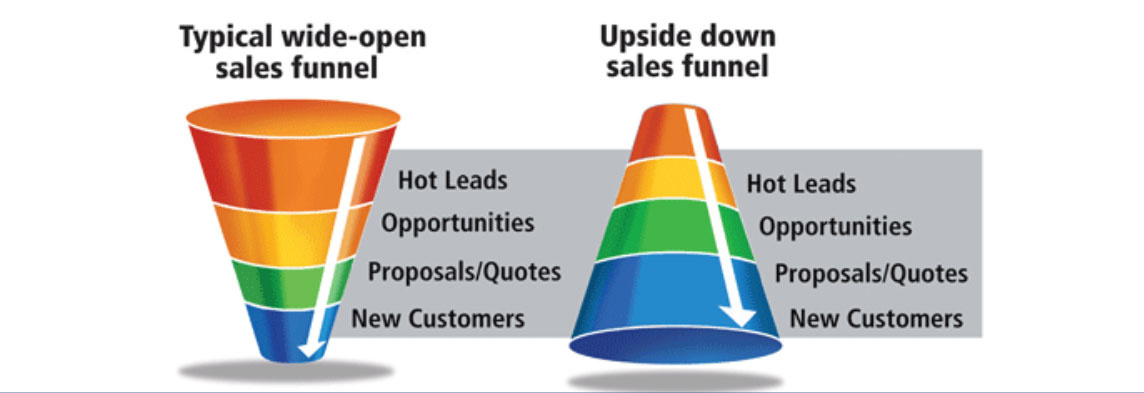
If you would like to read more about the Upside-Down sales funnel, you can read the whole article, Be Selective and Create Better Leads with an Upside-Down Sales Funnel.
In this article, we are going to explore how you can use your CRM and automation to guide qualified leads into your Upside-Down sales funnel. Automation helps you feed the right content to the right people at the right time. It takes the responsibility off you to remember to follow up (which can produce Follow Up Fatigue) and helps you sell more with less effort.
There are two types of automation that you can use to reduce Follow Up Fatigue and make your Upside-Down funnel more effective:
Time-Based Automation
Time-based automation is a workflow that triggers when a prospect interacts with your call-to-action (CTA). A CTA is content that prompts action by the prospector. Common CTA’s include a contact form on your website, sign up for a newsletter, or download a free resource to name a couple of ideas. After they complete the CTA, the time-based automation kicks in at that moment. Based on this timestamp, your workflow begins to feed content to your prospect.
Why do you need automation to feed content to your prospect from the moment they take action? To put it simply, automation does not get tied up with requests, meetings, and to-dos. It has one job to do. A job that you do not have to worry about.
There are different types of time-based automation that can be created in your CRM. Here are a few:
- A Welcome or Thank You email is sent to the prospects immediately after they take action.
- A drip campaign of relevant content that guides the prospect through the Buyer’s Journey.
- A reminder to take advantage of a limited-time offer or that their free trial is ending soon.
- An invitation to a scheduled demo for the product that they are considering.
- A follow-up “we miss you” email when the CRM has not logged activity after a certain time.
This list goes on and it can be customized according to your industry and audience. Your automated communication can be spread out over days and weeks or even ongoing from the time of the prospect’s first engagement.
Behavior-Based Automation
Behavior-based automation is like time-based in that it has a trigger. However, it is not triggered on a timestamp. Rather, it is based on a behavior or action. An action or behavior can be something that the prospect did or did not do. For example, you sent an automated email to the prospect. If they opened it and clicked on an offering, that is in action. If they opened the email and did not click on an offering, that is also an actor, so depending on the action, you can automate specific communication. If they clicked on the offering, you can send communication to guide them through the purchase. If they did not click the offering, you can send them another email with FAQs or additional relevant content to take them from consideration to decision. Behavior-based automation can be triggered in your CRM on the following:
- Subscribe to a newsletter
- Schedule a service
- Selected a specific option in your contact form dropdown field
- Did not open an email
- Did not complete a purchase
- Engaged with your social media
- Left a review
There are many different behaviors that can trigger automation based on your audience. CRM automation gives you the ability to create workflows based on what they do.
Conclusion
If you want to sell more with less effort, you need to adopt the Upside-Down funnel model and integrate automation. Using a CRM is the best way to do this. If you are not using a CRM or looking at alternatives for your current CRM, contact us to schedule a free demo of X2CRM, an open-source CRM that can be configured to your business goals with enterprise-level support.