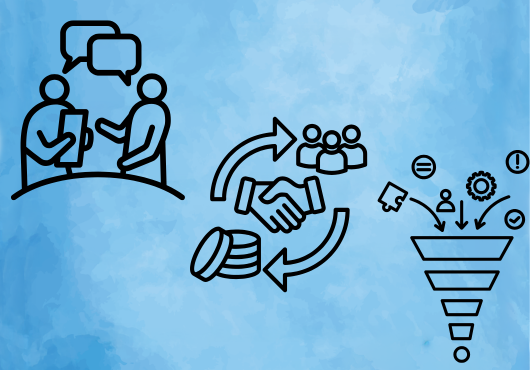
How do you know when marketing and sales are not aligned? Ask your sales funnel. A sales funnel shows whether marketing and sales are aligned by:
- Revealing lead types.
- Showing lead movement across funnel stages.
- Identifying where leads consistently stall.
The funnel tracks prospects across sales reps and estimates revenue.
As a business owner, VP of Sales, or Sales Manager, your sales funnel will tell you many secrets and is a primary communication tool for your team.
Executive Coach LLC (ECLLC)
For Years, ECLLC lived on a roller coaster. One quarter they closed three deals; the next quarter they scrambled. Partners made excuses but the real problem was invisible: their marketing and sales were not aligned, and no one could see it.
Marketing generated leads with articles, webinars, and referrals. Prospects were excited by big promises: “transform your operations,” “cut costs by 20%,” “build a scalable growth engine.” Then they hit the sales process.
Sales conversions were ad hoc. Partners had their own sales approaches, followed up with emails and calls when they remembered, and produced dense proposals that did not echo the outcomes that attracted prospects in the first place.
Follow‑up was a grind and no one knew:
- Which channels brought the right leads.
- Where deals consistently stalled.
- How many touches it really took to win or lose a client.
The result was feast or famine and constant follow up fatigue.
The Partners Decide
Recognizing their limitations, the partners sought outside help. Their sales funnel specialist reviewed their current prospects, recent sales, and methods. The Specialist drew a picture of ECLLC’s sales funnel stages: Awareness; Lead capture; Discovery; Proposal sent; and Won/lost.
The funnel showed the following:
- ECLLC attracted qualified prospects.
- Partners followed up too slowly for Discovery consults.
- Average “time in stage” exploded after proposals were sent.
- Leads from webinars produced their best leads.
The team realized its marketing message promised big outcomes while its proposals showed budgeted hours and limited results.
Turning On The Lights With A CRM Sales Funnel
The firm implemented a CRM and the specialist set up the funnel based on its drawing. Every lead lived in that funnel. Each stage had clear definitions, exit criteria, and standard actions (emails, call scripts, and next steps).
The CRM’s pipeline gave marketing and sales a shared scoreboard. The CRM was used to segment, personalize, and automate outreach and follow up.
The Impact: More Sales, Less Follow Up Fatigue
Within two quarters, the firm saw three big shifts:
- Win rates increased as prospects were nurtured, educated and qualified.
- Sales cycles shortened and fewer deals sat in “proposal purgatory” as every proposal had a scheduled review call attached.
- Salespeople spent more times with their most qualified prospects.
The same team, with the same services, created its durable sales pipeline by aligning marketing and sales around a visible, disciplined sales process.